01System
About SEIRAN
System specifications, performance and the origin of the name of SEIRAN, the NVIDIA DGX B200 supercomputer at Tokyo University of Technology.
On this page
The name
SEIRAN — The Blue Gale of Intelligence
“Seiran” is a word that appears in a poem by the monk Saigyō, composed when he visited Hachioji, and stands for intellect and wind. The English name “Blue Gale” expresses the new whirlwind of knowledge that AI brings.
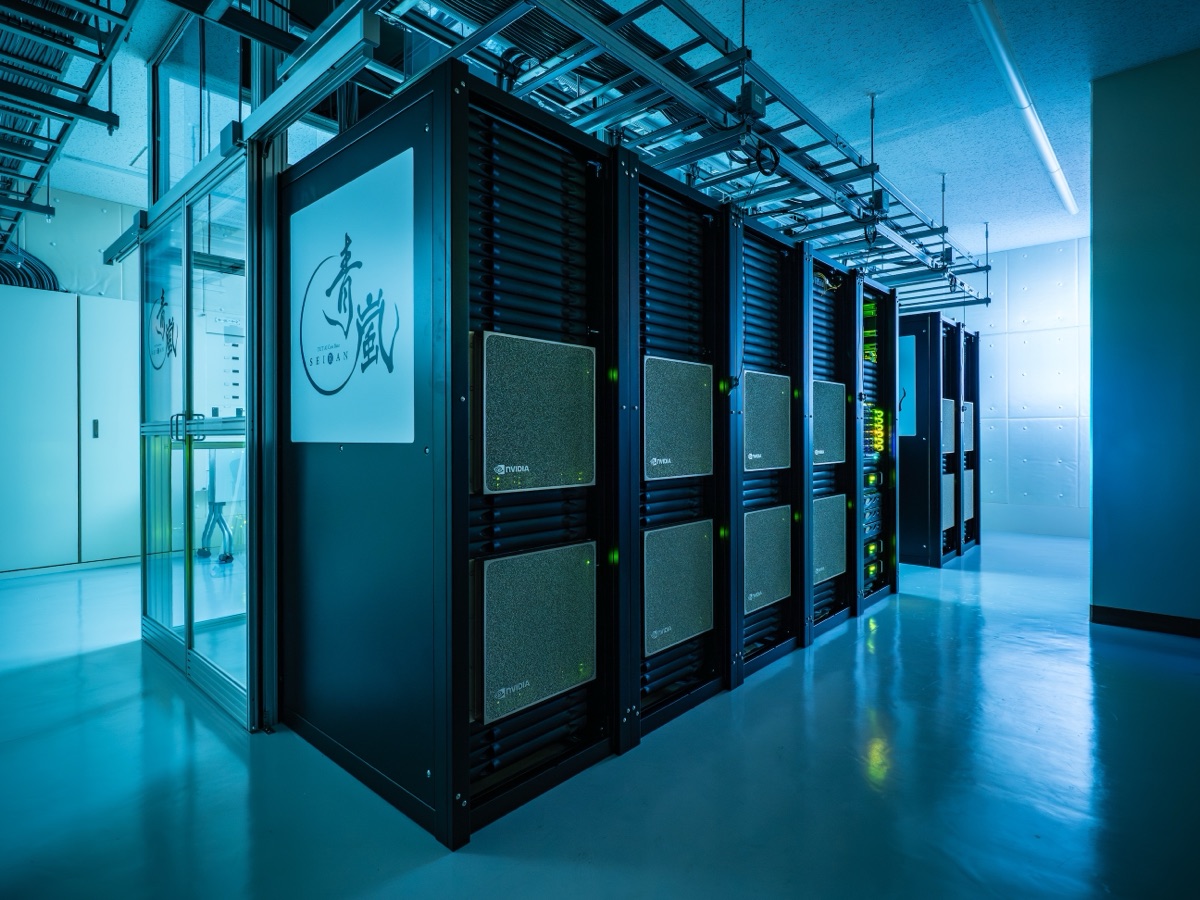
SEIRAN is a high-performance GPU supercomputer introduced by Tokyo University of Technology in 2025. It supports research and education, from training and inference of generative AI to scientific computing.

Hardware
Hardware configuration
SEIRAN consists of 12 NVIDIA DGX B200 systems based on the NVIDIA Blackwell architecture, with 96 GPUs in total.
Compute
- Compute nodes
- NVIDIA DGX B200 × 12 nodesBlackwell architecture
- GPUs
- 96 in total8 per node
- GPU memory
- 180 GBAs listed on the TOP500
- CPU
- Intel Xeon Platinum 857056 cores, 2.1 GHz
Performance
- HPL measured (Rmax)
- About 3.34 PFLOPS
- HPL theoretical peak (Rpeak)
- About 3.66 PFLOPS
- HPCG
- About 102.43 TFLOPS
- FP8 theoretical
- About 0.9 EFLOPSA theoretical value under a different precision and conditions
Network
- Inter-node links
- InfiniBand NDRConnects the 12 nodes
At benchmark submission
- OS
- Ubuntu 24.04.3 LTS
- TOP500 core count
- 15,552Not CPU cores alone
Rankings
Benchmarks and rankings
SEIRAN is listed on the TOP500 and HPCG, the performance rankings for supercomputers.
TOP500 world ranking (November 2026)
#421
Previous list (June 2026): #398.
HPCG world ranking (November 2026)
#95
November 2026 published results
- TOP500
- Ranks supercomputers by their measured performance solving a dense system of linear equations with HPL.
- HPCG
- A benchmark that includes sparse-matrix computation, memory access and communication, which matter in scientific computing.
Uses
Research applications
Digital twins
Supports research that recreates spaces such as cities and data centers in a virtual environment and connects them to simulation and AI-based analysis and prediction.
AI for Science and scientific computing
Supports large-scale parallel computation in fluid dynamics, electromagnetic field analysis and numerical linear algebra, as well as AI for Science research such as Physics-Informed Neural Networks (PINNs) that combine physical models with machine learning.
Generative AI and large language models
Supports research that needs GPU resources, such as training, fine-tuning and inference of large language models.
Explainable AI (XAI)
Supports research on methods that analyze and visualize the grounds for AI decisions, and their application to engineering, medicine and other fields.
Official sources
Rankings and HPL/HPCG performance figures are from the November 2026 lists. AI theoretical performance and HPL measured performance use different computing conditions.